

How to Leave a Group Without Causing Collapse
On not failing others or yourself


Any high I’ve ever felt from knowing it’s time to go gets instantly wilted by three thoughts in this order:
I don’t want to be the one who bails irresponsibly
But so much needs to happen to exit responsibly
Isn’t it easier, then, just to stay?
I have stayed for too long in working groups and volunteer organizer crews and clung to events I started without knowing how to pry my tired fingers away. The effort required to sustain community work – often volunteer-based, being taped together as it’s flying – feels like a miracle. I can’t shake the feeling that I’m somehow doing wrong by that miracle by needing to go.
It’s unfortunate that the best way I have to explain it is that scene at the end of Elf (spoilers) where everyone, even Buddy’s curmudgeonly dad, needs to sing a Christmas song in order to give Santa’s sleigh enough juice to keep going. Community work is like that. You have to look at the club you’re running or campaign you’re working or coalition you’re building and believe in it totally and unblinkingly, even though there are only two other people doing this with you and you’re all tired and there is no more help coming or end dates to your often boundaryless commitment. Plus the thing you’re building is so fantastic and meaningful. Sometimes the joy of this experience wipes my brain clean and I scuttle back and forth between resignation and elation and then a whole year passes from the moment I meant to go.
Leaving a group needs to be as normalized as joining a group is. It rounds out the lifecycle and creates an opening for new people and new eras. And if we are burnt out, less available, or just less interested, it’s the responsible thing to do. But the act of leaving can be so fraught that it never happens – or happens so quickly that it hurts the people and projects we care about.
I’ve written before about how commitments don’t have to last forever and well-designed exit routes make for better group participation and how important it is to decentralize yourself in a collective setting, but what if all the right things are in place and it’s still impossible to pull yourself away?
Leaving is a wrestling match with your ego
I believe the key to leaving without causing collapse is admitting that you are important and also not that important. It is when we accidentally stall on one of these that it gets weird. We either overinflate our essentialness or underestimate it. Waggle between feeling stuck or so impulsive that we could pick up and go without warning.
I have personally and within the same calendar week believed before that 1) I was the only one who could move my fellow club leaders through a strategic retreat and this is why I needed to stay forever even though I didn’t want to anymore, and 2) I could leave the next day and they’d be fine without me. If I dwelled too long in the first reality, the group would never survive without me and thus I could never in good faith leave them. In the other, I might drop out randomly and miss the chance to pass on a helpful tip or, you know, give some time to recruit enough help.
But both are true at once! I was important and I was also not that important. The opportunity for us, as leavers (this doesn’t have a great ring to it), is what we will do with that in-between.
Leaving without causing collapse is a deeply personal and context-specific experience for this reason. If you are having trouble knowing where to begin, here is a rough sequence of actions I’ve tried or experienced from others leaving:
Be honest about your intention to leave and ask the group what would be helpful in your absence. If this seems obvious, congratulations, you are less tortured than me! Stating this clearly kickstarts the process and creates movement so that the idea isn’t just fermenting in the back of your mind or appearing through quiet quitting, which honestly sucks in a volunteer context.
Give yourself a deadline to go. It’s important that this isn’t so short it gives your collaborators no time to prepare, and not so long that you can’t feasibly stick it out. Most important of all is that the deadline exists. I have found myself deferring to others here and stretching it out, but the truth is that even the most caring collaborators can’t know when it’s time to go like you do.
Explore if this is actually a moment for structural change. It may be hard to consider leaving because it existentially impacts the group itself. Maybe you founded the book club, or your facilitation skills are super specialized, or if there are so few of you it’s a big blow no matter what. What if it’s hard to imagine because it is actually indeed impossible? The structure itself could need changing, like going from a leadership group of a few to many, or changing up the frequency or intensity of what’s being planned so there’s a lighter load to carry.
Document your role and teach it to someone else, even if that person is the intermediary who will teach your eventual replacement. This also could be a surprising time where you learn a fellow organizer actually really wanted to learn how to make a fantastic flyer or basic event plan. Upskilling!
Offer (boundaried) help after you go, like a monthly check-in, or availability for a few months, or your review on something specific and intensive, like the next time a particular all hands meeting or fundraising need comes around. Note: If you suspect this could undermine your leaving, be appropriately paranoid here.
Accept that things will indeed change. Another deceptively simple one, but often what I need the most. At some point I notice that all of my efforts are in defiance of inevitable, healthy, change. It will be different without you. This will be out of your control and it is one of the best and hardest points about going.
What will they do without you?
A story about a community group in transition
The other day I dropped by the new space I’m opening (one reason why it’s been quieter around these newsletter parts) to make sure the contra dance group had everything they needed to do their thing and saw this:
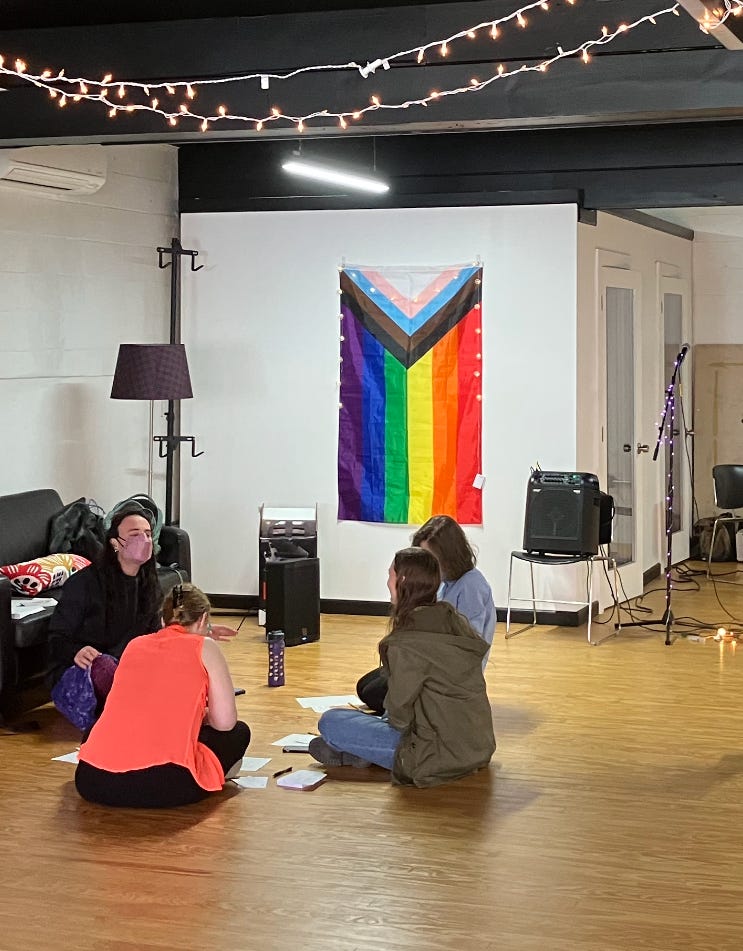
When I asked Abi Tenenbaum – one of the lead organizers and main dance caller – what was happening, she grinned and said: “It’s a Calling Workshop.”
If you’ve never done contra (you should), calling is the conveyer belt that keeps a dance moving. Callers first explain the steps of the dance and, when the number begins, remind dancers of what comes next in the intricate sequence.
Abi is the main caller for Lavender Contra, but she is moving this summer. That’s why these Calling Workshops are happening.
But in Abi’s words, “the goal is not to train up a replacement for me, but rather to usher the community into a new, more open era. With these workshops, I hope to empower our community to be self-reliant and self-perpetuating, to grow past any particular person or way of doing things.”
I was moved by how Abi described the experience of leading these transitional workshops not as some obligatory burden or slog, but as a meaningful exercise in themselves. “It has been so rewarding to reflect on what I’ve learned and offer my insights to the callers I’m training,” she said. “Running the workshops has definitely made me a better caller.”
Leaving a group can carry so much guilt that I’ve found myself ping-ponging between selfishness (I should just leave tomorrow) and overextension (there will never be enough I can do to prepare for my not being there.) The idea that an exit experience can be mutually beneficial rocked me, as did the idea of this acting as closure in itself.
“The satisfaction of calling a good dance now pales in comparison to the satisfaction of watching someone else call a good dance for the first time,” she said. (Yes, Abi is one of the kindest people on this planet!) “Thinking in these terms has pushed my feelings for this community and the people in it to a new level – it has deepened my joy, pride, and love.”
Stories like this make me wonder what the panicked question of ‘What will they do without me?’ sounds like if it shifts to its identical, but more hopeful rephrasing: What will they do without me?
or simply click that ₊˚.⋆⁺₊💜₊˚.⋆⁺₊ at the top if you indeed liked it, we always appreciate that here at group hug hq!! love to you all
💸 If you enjoyed this, consider dropping a buck in the GROUP HUG hat! This is an alternative to paid subscriptions to pass support from this newsletter onto groups in my town which I clearly draw all of my inspiration from.
Such a good call to interrogate all of the unexamined beliefs underlying a réticence to leave, and excited to hear more about this space! 👀